If you're wondering how to become a Virtual Assistant — or how to grow the VA business you've already started — you're in the right place.
(And the answers I've given thousands of times over 20 years — because they never should have had to wonder alone in the first place.)
Let me tell you what I've noticed after nearly three decades in this industry.
It's not that Virtual Assistants lack skills. It's not that starting a virtual assistant business is too hard or that the market is too crowded. The VAs who struggle — the ones who undercharge for years, who almost quit, who spin their wheels for months before anything clicks — almost all have one thing in common.
They're trying to figure everything out alone.
And the thing about doing it alone is that every unanswered question feels bigger than it is. Every slow week feels like proof you made a mistake. Every rate increase conversation feels impossible because there's nobody in your corner who's been there.
I've been coaching and supporting VAs since 1996. I've seen thousands of people come through this industry — some who built thriving businesses, some who burned out quietly and gave up.
The difference between those two groups is rarely talent. It's almost always whether they had the right people around them.
So here are the 30 questions I hear most — answered the way I'd answer them if you were sitting across from me. Not polished. Not corporate. Just real.
And at the end, I'm going to tell you the one thing that would have answered most of these questions before you even had to ask them.
— Tawnya Sutherland, VA Coach & MotiVAtor
📋 What's In This Post
Jump to the section most relevant to you right now:
➜ Section 1: Getting Started as a Virtual Assistant (Q1–Q5)
➜ Section 2: Virtual Assistant Rates & Packages (Q6–Q8)
➜ Section 3: How to Get Clients as a Virtual Assistant (Q9–Q13)
➜ Section 4: Running Your Virtual Assistant Business (Q14–Q20)
➜ Section 5: Growing Your Virtual Assistant Business (Q21–Q24)
➜ Section 6: Mindset & Real Life (Q25–Q28)
➜ Section 7: The Part Nobody Talks About (Q29–Q30)
SECTION 1: GETTING STARTED AS A VIRTUAL ASSISTANT

1. How do I know if becoming a Virtual Assistant is right for me?
Stop waiting for certainty you're never going to get. Here's a better question:
Are you organized, reliable, and do you genuinely enjoy making someone else's chaos run smoothly?
If yes — that's the job. You don't need a specific degree, a particular background, or a perfect plan to start a virtual assistant business. What you need is to decide you're doing this and then do it.
Readiness isn't something that shows up before you start. It shows up because you started.
2. What services should I offer as a Virtual Assistant?
The services you already know how to do. I mean that literally.
If you've spent years in your 9-5 job managing calendars, writing emails, running social media for someone else's business — those are real, billable skills right now.
The biggest trap I see new VAs fall into is waiting until they feel 'ready' — as if readiness is a destination you arrive at rather than something you build by starting.
Begin with what you have. Add as you grow.
3. Do I need a website before I find my first client?
Not on day one — but eventually, absolutely.
A well-optimized LinkedIn profile will outperform a rushed website every single time, and I've watched VAs land solid retainer clients with nothing but a great profile and the nerve to reach out.
But every VA needs a professional website eventually. It's your digital storefront, your credibility signal, and often the thing that tips a potential client from curious to convinced.
Start with LinkedIn. Then build a website you're actually proud of.
👉 We offer VA-specific website packages at VAnetworking.com — no tech headaches required
4. Do I need certifications or formal training?
No outside certification is required to start as a VA. But training is a completely different conversation.
When you complete our Virtual Assistant Career program, you don't just get a working blueprint for your business — you come out the other side as a certified VA.
That certification matters. It tells potential clients you took this seriously enough to do it properly, and it gives you something real to point to when someone asks why they should hire you over the next person.
In an industry where anyone can call themselves a VA, that distinction matters more than most people realize.
👉 Start your VA Career training at VirtualAssistantCareer.com
5. Do I need to register a business to work as a VA?
Eventually, yes — and sooner rather than later.
The good news is it's usually simpler than people expect. In most countries, starting as a sole proprietor requires minimal paperwork and costs very little to set up.
As you grow, you'll want to look at more formal structures for liability protection:
- In the US, an LLC keeps your personal assets separate from your business
- Other countries have their own equivalent structures
- Your local government business office is a great free starting point
Don't let the business registration piece be the thing that stalls you — it's a few forms, not a law degree.
SECTION 2: VIRTUAL ASSISTANT RATES & PACKAGES
6. How much should I charge as a Virtual Assistant?
More than you currently think. That's not a pep talk — it's a pattern I've watched play out hundreds of times.
Here's what the market actually looks like:
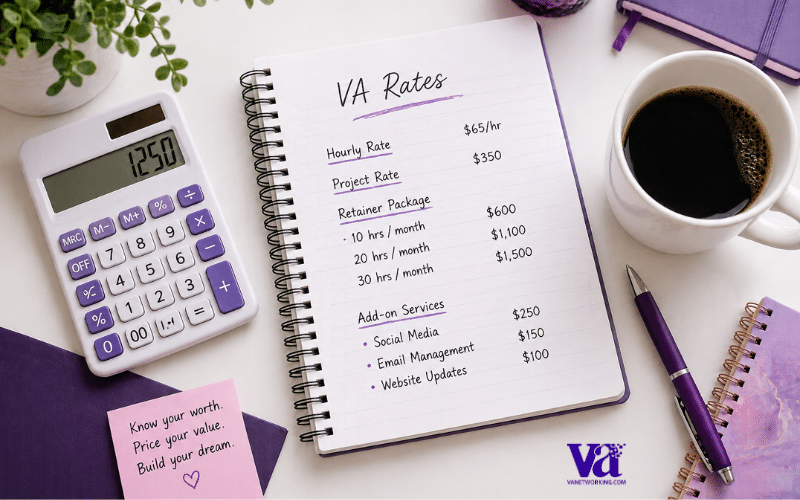
- General admin work: $30–$50/hour
- Specialized skills (bookkeeping, tech, social media strategy): $65+/hour
- The number most VAs start at is lower than any of those — because they're pricing from fear instead of value.
Figure out what the market pays. Charge that. Not less.
👉 Not sure what to charge? Use our rate calculator here
I've coached so many VAs through this that the conversation has become almost predictable.
They come to me exhausted, working constantly, barely covering their bills. They're charging $15 or $18 an hour because they started low to 'build experience' and then couldn't figure out how to get out from under it.
Here's how it usually goes: clients got used to the rate, and the VA felt too guilty to change it. So she just kept going — more hours, same money, growing resentment.
We'd work through her actual market value, build a rate increase plan, script the client conversation word for word. One VA went from $18 to $45 an hour. Same skills. Same work. The only thing that changed was that she stopped letting her fear set her prices.
If you recognize yourself in that story, hear this: you are not doing anyone a favor by staying cheap.
7. How do I create packages as a general admin Virtual Assistant?
Stop thinking about what you offer and start thinking about what problem your client needs solved every single month.
A package isn't a menu — it's a promise.
'I will handle your inbox, your calendar, and your travel booking for $400 a month' — that's a package. It's predictable for them and manageable for you.
Look at the tasks you do most often for clients and ask: could I bundle these into a recurring monthly offer with a flat price?
The answer is almost always yes. And packages quietly solve the scope creep problem too — which we'll get to shortly.
8. How do I raise rates with clients who are used to paying less?
You tell them directly, with 30 days notice, in one short message.
Something like: 'I wanted to give you plenty of notice that my rates are moving to X on [date]. I've loved working together and I'm looking forward to continuing.'
Full stop. No novel explaining your reasoning. No apology. No negotiating against yourself before they've even responded.
Most clients who actually value your work will stay. The ones who leave were underpaying you anyway — and now you have room for someone who won't.
👉 Want help getting fully booked at your new rates? Check out the Get Clients Club
SECTION 3: HOW TO GET CLIENTS AS A VIRTUAL ASSISTANT

9. How do I find my first client as a Virtual Assistant?
Tell the people you already know what you're doing. I know that sounds too simple. Do it anyway.
Your first client is almost certainly already in your network — a former colleague, a business owner you know from somewhere, a friend who keeps complaining about being overwhelmed.
They just don't know you're available.
Most VAs spend months building systems for attracting strangers while ignoring the people who already trust them. Start there.
10. What marketing tactics actually work?
The tactic that works is the one you'll actually do consistently for more than three weeks.
But if you want specifics, here's what actually works for Virtual Assistants:
- LinkedIn — dramatically underused by VAs and overused by the clients who need them. Start here.
- Referrals — your highest-converting lead source. Ask happy clients directly.
- Online communities in your niche — not VA groups, but where your ideal clients hang out. Show up helpfully.
- Networking — online or in person. Most VAs land their best long-term clients this way.
Pick two. Do them for 60 days before you decide they're not working.
11. How do I find my niche?
Start by looking at three things:
- The services you most enjoy doing
- The industries you already understand from your 9-5 job or past experience
- The types of clients you genuinely like working with
Where those three overlap — that's your niche sweet spot.
You probably won't have perfect clarity until you've worked with a few different clients, and that's completely fine.
Start broad, pay attention to what feels right, and let the niche reveal itself as you go.
Want to go deeper on this? I wrote a whole post breaking down exactly how to find your virtual assistant niche — including the 4 biggest niche myths that are probably holding you back right now. Read it now →
12. Should I niche or not?
Here's the thing most VAs get wrong about niching: they think choosing a niche means turning away everyone outside it. It doesn't.
A niche is a focus, not a fence.
It keeps your ideal client front of mind, makes your marketing sharper and less scattered, and makes it infinitely easier to speak directly to the person you most want to work with.
Nothing — nothing — stops you from taking on a client outside your niche if the fit is right. You're not signing a contract with the universe. You're just deciding who you're talking to when you market yourself.
The Virtual Assistants who stay generalists forever usually aren't doing it out of strategy. They're doing it out of fear. And fear is a terrible business plan.
13. What should happen on a discovery call?
You should be listening about 70% of the time.
Ask them:
- What's overwhelming them right now
- What they've tried
- What's working and what isn't
Your goal is simple: understand their problem deeply enough that you can position yourself as the solution.
Because that's what a discovery call really is — it's not a job interview, it's a problem-solving conversation. By the end of it, the client should feel heard, and you should know exactly whether you can fix what's broken for them.
Then — and only then — talk about how you work and how hiring you solves the specific problem they just told you about.
Be clear about next steps at the end. And remember — you're evaluating them just as much as they're evaluating you.
Not every client is the right client. Come with questions written down. Leave knowing exactly what your next move is.
SECTION 4: RUNNING YOUR VIRTUAL ASSISTANT BUSINESS

14. Do I really need a contract?
Yes. No exceptions. Not even for people you trust. Not even for short projects. Not even when it feels awkward to bring it up.
Think of your contract as your professional handshake — it gets everyone on the same page before a single task is completed and protects both you and your client if anything goes sideways.
I've watched Virtual Assistants lose thousands of dollars and months of emotional energy over agreements that existed only in email threads and good faith.
Don't be that VA.
A solid freelancer's contract covers:
- What services you're delivering
- What you're charging and when you get paid
- What happens if payment is late
- How either of you can exit the agreement
- Who owns the work you create
- A confidentiality clause to protect both parties
We give away a free Virtual Assistant contract right here — so there's zero excuse not to have one.
And here's my one non-negotiable piece of advice: once you have your contract, have a legal professional look it over before you use it. This is the moment to bring a pro into your business. It costs less than you think and it's worth every penny.
15. Do I need business insurance?
Business insurance isn't something most VAs think about when they're starting out — and honestly, it's not a make-or-break requirement to get going.
Whether it makes sense for you depends on a few things:
- Where you live
- What services you offer
- Your budget and comfort level with risk
The most relevant type for VAs is Professional Liability insurance — also called Errors & Omissions — which covers you if a client ever claims your work cost them money. General Liability covers broader risks.
In some countries it's very affordable and a no-brainer. In others the cost may not justify it at your current stage.
Do your research, get a quote, and make the decision that's right for your situation. It's like house insurance — most people never make a claim, but nobody cancels it after a fire.
16. How many clients do I need to be sustainable?
Three to five solid retainer clients is the sweet spot most established VAs land on — but the real answer depends on your income goals and how many hours you want to work.
Here's the math that changes everything:
- A VA charging $30/hour who wants $3,000/month needs 100 billable hours
- A VA charging $65/hour needs less than half that
This is why your hourly rate matters so much — the higher you charge, the fewer clients you need to hit the same goal.
One-off projects pay the bills in the short term. Retainers — a fixed monthly fee for a defined scope of work — are what let you actually plan your life.
Build toward three solid retainers, and you'll feel the difference immediately.
17. How do I handle scope creep?
With a clear contract and one short, professional response:
'I'd love to help with that — it falls outside our current scope, so I'll put together a quick proposal for the additional work.'
You're not being difficult. You're running a business.
This is not a conversation to dread — it's a conversation to have once, handle calmly, and move on from.
Clients who respect you will respect the boundary. Clients who don't are a problem waiting to happen anyway.
18. What do I do when I make a mistake?
Own it immediately.
A short, direct message: 'I made an error — here's what happened, here's how I'm fixing it.'
No spiralling. No over-explaining. No waiting to see if they notice.
Clients don't remember the mistake nearly as clearly as they remember how you handled it. Transparency under pressure is one of the most trust-building things a VA can do.
Some of the strongest client relationships I've seen were built on the back of a mistake handled well.
19. What do I do when a client doesn't pay?
Here's the truth — if you set your business up correctly, a client not paying should never happen in the first place.
I teach all my VA students the same thing: Get payment upfront, before work begins.
And here's a little secret most people don't know — collect payment even before they sign the contract. Why? Because once someone has paid, they're not going to nitpick every clause in your contract. They're committed. They'll sign.
It's the people who haven't paid yet who suddenly have opinions about every paragraph.
Making upfront payment feel attractive is easier than you think — offer a small discount as an incentive:
- 10% off a 10-hour retainer paid upfront
- 20% off a 40-hour retainer paid upfront for the month
Clients love a deal, you get paid before you lift a finger, and everyone starts the relationship on solid ground.
20. What tools should every Virtual Assistant know?
The basics that come up constantly:
- Google Workspace and/or Microsoft Office — non-negotiable
- Project management: Asana or Trello are great examples. We currently use Clickup
- Scheduling tools: TidyCal or Metricool. We use both!
- AI assistant: Claude or ChatGPT — saves hours every week on writing, research, and brainstorming
Beyond that, it really depends on your niche:
- Bookkeeper? You may need QuickBooks
- Web developer? Dreamweaver and your platform of choice
- Social media VA? Canva and a scheduling platform
You don't need to know every tool before you start — you just need to be willing to learn the ones your clients use.
Adaptability is one of the highest-value skills a VA can have.
👉 Check out our top 60 VA tools list — free at vanetworking.com/free-work-from-home-tools
SECTION 5: GROWING YOUR VIRTUAL ASSISTANT BUSINESS

21. What's the difference between a VA and an OBM?
Think of it this way — a VA does the work, an OBM manages the people doing the work.
As a VA, you're in the trenches: scheduling, writing, admin, social media, whatever your clients need done.
An OBM zooms out and runs the whole operation — managing a team, overseeing launches, keeping all the moving pieces on track. OBMs charge more because the responsibility is bigger.
Nobody hands you an OBM license — you earn it through experience, by proving you can handle more, and often by growing naturally into the role with a client you've already been working with closely.
It's not a title you buy. It's one you grow into.
22. What VA niches are in demand right now?
The honest answer is that almost any niche can be profitable if you're good at what you do. That said, some areas are on fire right now:
- AI Support VAs — the biggest opportunity in the space right now. Businesses are scrambling to implement AI tools and VAs who understand them are becoming invaluable almost overnight.
- Social Media Management — still strong, but specialize within it (short form video, Pinterest) to stand out.
- Bookkeeping & Finance VAs — always in demand because numbers never go out of style.
- Tech VAs — funnels, websites, automations. Commanding premium rates.
- Podcast Management — growing fast as businesses lean into audio content.
- Executive Support — for online coaches and course creators. A niche that just keeps expanding.
The VA industry has evolved way beyond admin work. The more specialized and tech-savvy your skillset, the more you can charge and the easier it is to stand out.
And if you want to future-proof your VA business, learning AI tools right now is the single smartest move you can make.
👉 Get AI-ready with our AI VA Mastery course at AIVAmastery.com
23. What does it mean to scale your VA business?
Scaling simply means growing your income without trading more hours for more money.
As a solo VA there's a ceiling to what you can earn — there are only so many hours in a day. Scaling is how you break through that ceiling.
Here are the main ways VAs do it:
- Raise your rates so each hour is worth more
- Package your services so you're selling value instead of time
- Hire subcontractors so you can take on more clients than you could handle alone
- Create digital products or templates that your clients can buy
- Build affiliate marketing income by recommending tools and resources you already use and believe in
- Move into an agency model where you're managing a team
Scaling looks different for everyone. The key is being intentional about it instead of just working more hours and hoping for the best.
Every VA deserves to know there's a ceiling — and exactly how to bust through it.
24. Can I really make a full-time income as a VA?
Can you? I did it in my first month. And before you think that sounds easy, let me be real with you.
I was a single mom with three kids to feed and house, rent due at the end of the month, and absolutely no safety net.
I wasn't working hard because I was motivated. I was working on fumes because I had no choice.
That's not the path I'd wish on anyone — but it taught me something important: your timeline has everything to do with your drive, your passion, and your why.
When your why is big enough, you move differently.
That business I built on fumes? It eventually became a six-figure income.
On average, most Virthal Assistants are fully booked within their first three months when they're intentional about it — and that's not a guess, that's what I've watched happen consistently since 2003.
If getting clients feels like the hardest part, that's exactly what we built GetClientsClub.com for.
👉 Get booked solid at GetClientsClub.com
SECTION 6: MINDSET & REAL LIFE

25. I'm an introvert. How do I market myself?
By stopping trying to market like an extrovert.
Cold calling, loud networking events, daily performance content on social media — none of that is required.
Introverts tend to be:
- Thoughtful writers
- Deep listeners
- Genuinely good at one-on-one conversations
Those are exceptional marketing assets.
A well-written LinkedIn profile, a few helpful posts a week, and real engagement in online communities where your clients already are — that's a full marketing strategy.
You don't need to be the loudest voice. You need to be the most useful one.
👉 Connect with thousands of VAs in the VANA Community — vanetworking.com/vana-community
One VA I coached was completely convinced she couldn't market herself. The idea of 'putting herself out there' made her feel sick.
Networking events were out. Daily social media posts felt like performing in public.
So instead of forcing her into a strategy built for someone else's personality, we built one for hers. Thoughtful LinkedIn posts written from her desk. A couple of online communities where she could genuinely help people. A profile that did most of the selling before anyone even spoke to her.
Within a few months she had more enquiries than she could take on. She never attended a single in-person event.
Introversion isn't a marketing disadvantage. Trying to market as someone you're not, is.
26. Can I do this with kids at home?
Yes — and I'm living proof.
I built my VA business with three kids at home, and it was one of the most fulfilling decisions I ever made.
I was there when all three got chicken pox at the same time. I was there in seconds when my son knocked out his teeth at the park and needed to get to the dentist fast enough to save them.
Those are the moments you can never get back — and I didn't miss a single one because I was working from home on my own terms.
And here's something most people don't realize: my clients had no idea I had kids. Why would they? Your personal life is your personal life. What your clients care about is whether their work gets done on time and communication is reliable — and mine always was.
Working from home with family around does require some ground rules:
- Train your kids and family to respect your business hours
- A sign on the door — 'Mom's on a call, do not disturb' — works better than you'd think
- Set clear boundaries around when you're working and when you're available
Build your business around your life — not the other way around — and you'll wonder why you ever considered any other way of working.
27. How do I handle the loneliness of working alone?
By not pretending it's not real.
Working from home is genuinely isolating in a way that people who've never done it don't understand.
The fix isn't forcing yourself to love solo work — it's building the human connection you need deliberately.
A few things that genuinely help:
- Set a real schedule so your day has structure
- Get out of the house a few times a week
- Find a community of people who are actually in this work — not a Facebook group full of
- strangers, but real relationships with people who get the specific texture of this life
That's exactly why thousands of VAs have called the VANA Community their second home since 2003. It's private, it's real, and there's always someone in there who gets exactly what you're going through.
👉 Come find your people at The VANA Community
28. How do I handle a difficult client?
First, try to fix it. Most difficult client situations trace back to unclear expectations at the start.
Unclear scope. Unclear communication style. Unclear deliverables.
Better contracts and clearer conversations before the work begins will prevent most problems before they start.
But sometimes you do everything right and the client is just wrong for you.
And here's something nobody talks about enough: a truly difficult client doesn't just affect your work — they take over your whole life.
- You're thinking about them in the shower
- You're dreaming about them at 3am
- You're dreading opening your email in the morning
That kind of stress bleeds into everything and it is not worth it.
Be firm, have the conversation, and if it's not working — dump them. Professionally, kindly, but without guilt.
Life is too short, and your business is too important to carry a client who's making you miserable. The right clients are out there. Make room for them.
SECTION 7: THE PART NOBODY TALKS ABOUT

29. Is there a community for VAs that's actually worth joining?
I'm going to be direct with you: most of the free groups aren't.
They're noisy, unvetted, and — critically — your potential clients can see everything you post.
Asking 'how do I handle a client who won't pay' in a group where other business owners are members is not a good situation.
The VANA Community is different, and I don't say that because I built it. I say it because I've watched what happens to VAs when they find it.
It's been running since 2003. It's private. It's moderated. It has:
- 27,000+ topics and 155,000+ posts from people actually doing this work
- Direct access to me — showing up every day, not as a figurehead but as someone still actively in this industry
- Monthly challenges with weekly action steps so you always know what to focus on
- The VANA Seal of Approval — display it on your website for instant credibility with clients
I've seen the same thing happen so many times it has its own shape.
A VA joins after months — sometimes years — of going it alone. They've been second-guessing everything: their rates, their services, their decision to do this at all.
They post their first question inside the community a little nervously, not sure if it's too basic. Within hours, they have answers from people who've been there, encouragement from people who mean it, and the particular relief of realizing they're not the only one who wondered this.
Something shifts. They start showing up more. Asking more. A few months in they're the one answering questions for the newest members.
The isolation that was making every small setback feel enormous gets replaced by something that actually holds you. That's what community does when it's real. It doesn't just answer your questions. It changes the experience of the whole thing.
30. What do the most successful VAs have in common?
I've been watching VAs succeed and struggle for nearly three decades, and the pattern is remarkably consistent.
The ones who build thriving businesses aren't necessarily the most talented or the most experienced. They share three things:
1. They invested in proper training early. They didn't try to piece it together from free Facebook posts and YouTube rabbit holes. They found a proven roadmap and followed it. Our Virtual Assistant Career program at VirtualAssistantCareer.com is exactly that — step by step, built specifically for VAs, with a certification at the end that sets you apart.
2. They found a mentor or coach who had already done it. They didn't reinvent the wheel — they borrowed someone else's map. If you want someone in your corner who's been there, our coaching options at a Coach in Your Purse are a great place to start.
3. They surrounded themselves with the right community. They stopped going it alone and found people who lifted them up, answered their questions honestly, and kept them accountable. That's what the VANA Community has been doing since 2003 — and it's waiting for you at the VANA Community.
Training. Mentorship. Community. That's the whole formula.
Everything you need is already out there. The only question is how long you're going to wait before you go get it. 💜
Ready to Build Your VA Business the Right Way? 💜
The VANA Community is the longest-running private network for Virtual Assistants in the world. Over 20 years of real conversations, real advice, and real relationships — in a private space where clients can't see a thing.
For less than the cost of two coffees a month, you get:
- Private access to 27,000+ topics and 155,000+ posts — real answers from real VAs
- Direct access to me — not a bot, not a content library, me
- Monthly challenges + weekly action steps so you always know what to work on next
- Up to 20% off VANA training plus deals on the tools serious VAs actually use
- The VANA Seal of Approval for your website — instant credibility with clients
You've been doing this alone long enough.
👉 Join the VANA Community here — I'd love to personally welcome you in.